

Primary angle closure refers to a physiological abnormality where the angle of the eye, responsible for draining aqueous humor from the anterior chamber and maintaining fluid balance, functions poorly. This leads to increased intraocular pressure (IOP) and raises the risk of acute angle closure crises and chronic angle closure glaucoma.
Causes include congenital narrow angles (primary angle closure), often with genetic predisposition and more common among Asians, as well as secondary causes like cataracts or lens swelling pushing the iris forward.
Under normal circumstances, the eye continuously produces aqueous humor, which flows from the posterior chamber (behind the iris) to the anterior chamber (in front of the iris). From there, it drains out through the angle of the eye via a sieve-like structure called the trabecular meshwork, where it is reabsorbed into the bloodstream.
In the absence of acute IOP elevation, primary angle closure is typically asymptomatic and can only be detected during an eye exam using specialized techniques. These include slit-lamp biomicroscopy and contact gonioscopy, as well as additional diagnostic tools to confirm the condition and guide treatment.
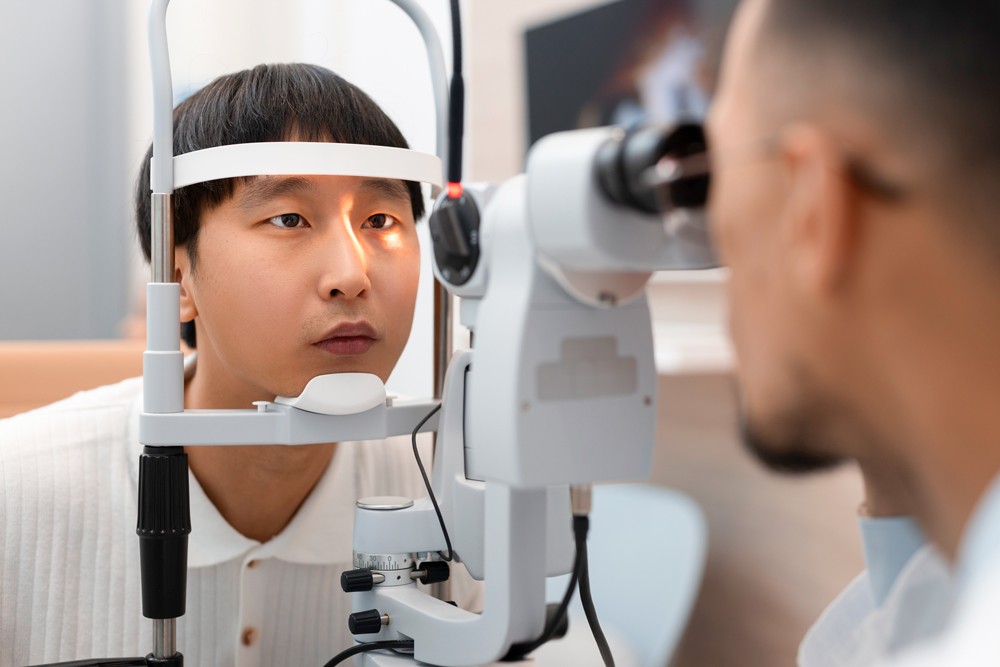
If a wide-angle closure is detected over more than 180 degrees, even without symptoms, preventive treatment with laser peripheral iridotomy is recommended. This procedure reduces the risk of acute angle closure crises and chronic angle closure glaucoma.
For more information, please contact:
 Ophthalmology Department, 1st Floor, RAM 2 Hospital
Email: information@ram2-hosp.com
Line Official: @ram2
Tel: 02-032-3888
Recommend Doctor of Ophthalmology

Dr.Kamolchanoke Nimsawas
Ophthalmology
RAM 2 Hospital


Dr.Montana Supawongwattana
Ophthalmology
RAM 2 Hospital