
พญ. อรณิชา ชัยเศรษฐสัมพันธ์
กุมารเวชศาสตร์โรคภูมิแพ้และภูมิคุ้มกัน (Pediatric Allergy and Immunology)



Influenza is often a common illness that many have grown accustomed to. However, each wave of influenza tends to be more severe than the previous years, starting with the tragic death of a well-known Taiwanese celebrity, a major outbreak in Japan, and escalating into the worst outbreak in 15 years. The strains that people are most commonly contracting are undoubtedly ‘Influenza Strains A and B’
Influenza strains A and B are the most common types found in humans. Strain A in particular can spread widely because it mutates and transmits rapidly, whereas Influenza B usually causes more localized outbreaks. Glycoproteins on the viral surface such as Haemagglutinin (HA) and Neuraminidase (NA), abbreviated as “H” and “N” followed by a “number,” are key factors enabling transmission between humans and animals.
Furthermore, when conditions favor virus development and mutation to the point where existing immunity can no longer protect us, the situation becomes even more hazardous. Both strains cause severe symptoms and carry a high life-threatening risk, especially among the elderly and young children who have weaker immune systems.
Influenza A is caused by the novel influenza A virus (H1N1), which resulted from genetic mixing between human, swine, and avian influenza viruses. Consequently, transmission can occur through both ‘animals to humans’ and ‘humans to humans’ via inhaling respiratory droplets from coughing or sneezing, or by touching contaminated objects and inadvertently touching the nose, eyes, and mouth.
Influenza B is caused by the Influenza B virus, which is one of the viruses responsible for winter outbreaks. Its infection pattern is similar to Strain A, although it is generally less severe.
Symptoms can appear variously within 1 - 3 days after exposure, including high fever, chills, dry cough, sore throat, poor appetite, and body aches. In some young children, seizures may occur. Generally, symptoms following infection with Strain B tend to be less severe than those of Strain A . However, individuals with severe symptoms may experience dehydration and complications such as pneumonia or atrial fibrillation.
As numerous news outlets have repeatedly warned about the dangers of this severe outbreak in 15 years—partly driven by vaccine fatigue—doctors wish to expand upon this issue to help readers better understand.
Vaccine Fatigue (Vaccine Fatigue) stems from the continuous need for vaccination since the previous COVID-19 pandemic, causing people to feel weary from prolonged vaccination schedules. Some may question the effectiveness of vaccines, wondering not just “whether it protects us,” but also “how well it protects us.”

Nevertheless, because influenza mutates rapidly alongside COVID-19 which remains with us indefinitely, prevention is certainly ‘better’ than cure.
Receiving the quadrivalent influenza vaccine 4 strains, which includes strains A (H1N1, H3N2) and strains B (Victoria, Yamagata) , is an effective way to save lives across every outbreak wave. It is recommended for everyone aged 6 months and older. Immunity lasts for about 1 year after just 1 dose, reducing the risk of contracting influenza by 70 - 90 percent.

Because influenza viruses are further categorized into subtypes based on surface proteins, such as Influenza A carrying H1 and N1 proteins. Therefore, even if a patient has immunity against one Influenza A strain, if they encounter a different subtype, they remain at risk of infection and severe symptoms. Getting the 4-strain influenza vaccine provides more comprehensive protection against this risk.
Vaccination timing depends on individual needs, but generally, before the rainy and winter seasons (March - May, October - November) is the most suitable period as flu activity peaks during these times.
Vaccinated individuals should allow at least 2 weeks for immunity to develop before deciding to travel internationally where infection risks may be higher.
For more information, contact
 Internal Medicine Department 1st Floor
Email: information@ram2-hosp.com
Line Official: @ram2
Tel: 02-032-3888, 095-771-9739
Recommended Packages

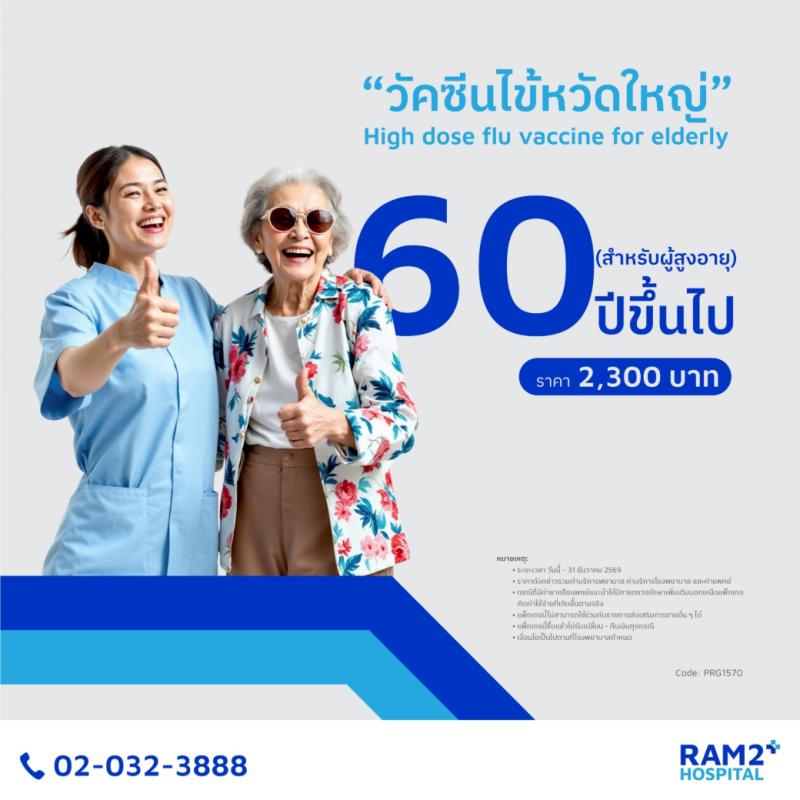
Quadrivalent Influenza Vaccine - 1 Dose

กุมารเวชศาสตร์โรคภูมิแพ้และภูมิคุ้มกัน (Pediatric Allergy and Immunology)

กุมารเวชศาสตร์โรคต่อมไร้ท่อและเมแทบอลิซึม ( Pediatric Endocrinology and Metabolism )

กุมารเวชศาสตร์พัฒนาการและพฤติกรรม (Developmental and Behavioral Pediatrics)